
If you have explored Feng Shui before, you have probably encountered a diagram divided into eight areas surrounding a center.
This is the Bagua.
It is one of the most recognizable tools in Feng Shui, but also one of the easiest to oversimplify.
A Bagua is sometimes presented as little more than a map showing a "wealth corner", a "relationship corner", a "career area" and several other areas of life.
Then comes the inevitable advice:
Put this object in that corner to improve that part of your life.
But before moving anything around your home, it is worth understanding what the Bagua actually represents, how it is positioned, and how it fits into the much larger picture of Feng Shui.
What Is the Bagua?
The Bagua is a map used to organize and study different energetic influences within a space.
Traditionally, it is represented by eight sections surrounding a central area, the Tai Chi.
In many contemporary applications, these eight surrounding areas and the center are represented as a square divided into nine sections.
This gives us a practical framework for applying the Bagua to modern floor plans.
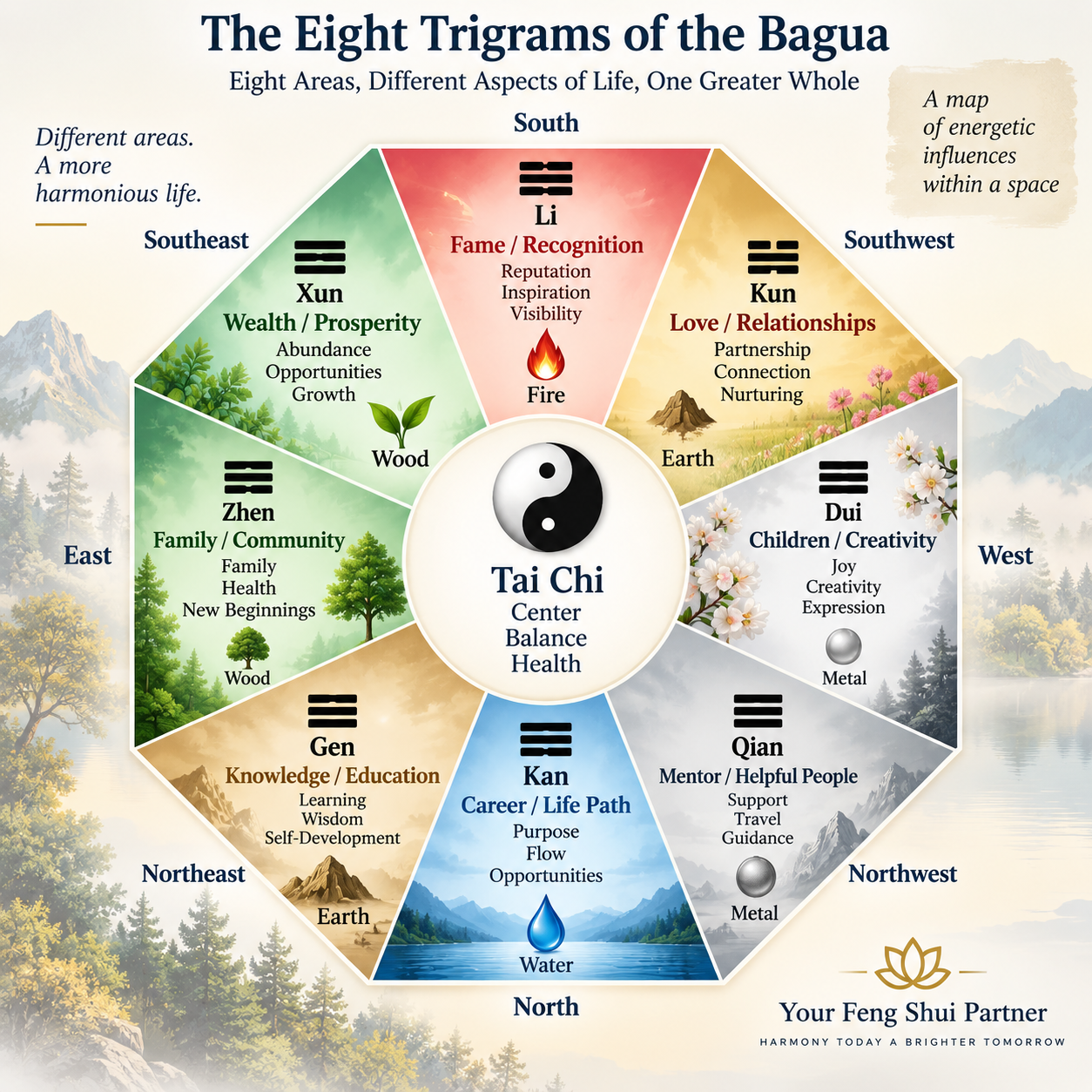
The Bagua Can Be Applied at Different Scales
One of the most useful ideas to understand is that the Bagua is not restricted to an entire house.
A Bagua can be considered at several scales:
- the plot of land,
- the house or apartment,
- an individual room,
- or even a smaller working space such as a desk.
The principle remains similar:
We divide a defined space into energetic areas so that we can understand what each part of that space represents.
This is important because Feng Shui works through layers.
We can study the environment surrounding the property, then the property itself, and then individual areas within it.
From Big Feng Shui to the Bagua
In our previous article, Big Feng Shui vs Small Feng Shui , we established an important principle:
Big Feng Shui comes first.
Before studying the internal sectors of a home, we should understand the larger environment supplying energy to the property.
Mountains, water, roads, neighboring structures, orientation and building form all belong to this larger picture.
Once we understand the energy reaching the property, the Bagua becomes one of the tools that helps us investigate what is happening at a more detailed level.
Big Feng Shui asks: What energy reaches the property?
The Bagua helps us ask: How is the space energetically organized?
What Do the Eight Areas Represent?
The Bagua associates different areas with different qualities and aspects of human experience.
In the terminology used within the YFP tools, these include:
- Career,
- Knowledge / Education,
- Longevity / Family / Community,
- Wealth,
- Fame / Recognition,
- Love / Relationships,
- Descendants / Creativity,
- Mentor / Travel.
Each sector can also be associated with other characteristics, including colors, numbers, seasons and the Five Elements.
This is where the Bagua starts becoming much more than a floor-plan grid.
The Bagua and the Five Elements
Wood, Fire, Earth, Metal and Water appear throughout Chinese metaphysics, and the Bagua is no exception.
Different Bagua sectors are associated with different elemental qualities.
This matters because the Five Elements do not exist independently. They interact.
Through relationships such as the Creative Cycle and the Controlling Cycle, one elemental influence can support, transform or control another.
If you have already read our guide to the Five Elements , you will recognize the same fundamental energetic language appearing here in Feng Shui.
This becomes particularly important when we eventually consider objects, materials, shapes and colors within a Bagua sector.
Knowing the Bagua Is Not Enough — We Must Position It
Imagine that we now have a floor plan of your home and a Bagua map.
We want to know which room corresponds to which sector.
There is still one fundamental question to answer:
How should we orient the Bagua over the floor plan?
This is where two different approaches become particularly interesting.
At Your Feng Shui Partner, we work with both the Compass Bagua and the Doorway Bagua.
Compass Bagua — The Earth Provides the Reference
The Compass Bagua is oriented according to actual compass directions.
North is associated with Career, South with Fame and Recognition, and the remaining areas are positioned according to their corresponding geographical directions.
This means that a sector does not move simply because the entrance of the building changes position.
North remains North.
Compass Bagua asks: Where is this area in relation to the Earth's directions?
Why YFP Uses Eight Compass Sectors Rather Than a Simple 3 × 3 Grid
This is a small technical point, but an important one.
A building is rarely aligned perfectly with North, Northeast, East, Southeast, South, Southwest, West or Northwest.
If we simply force compass directions into nine rectangular boxes, we can easily misrepresent which direction actually passes through a particular room.
For Compass Bagua analysis, YFP therefore divides the space into eight 45-degree directional sectors.
The sectors radiate from the center of the property rather than behaving like nine fixed rectangular boxes.
When direction is the reference, the geometry should respect the direction.
Doorway Bagua — The Entrance Provides the Reference
The Doorway Bagua uses a fundamentally different reference.
Rather than positioning the map according to geographical compass directions, the grid is aligned relative to the main entrance of the space.
The floor plan is considered with the main entrance along the front edge of the Bagua.
The areas are therefore determined by their position relative to the entrance rather than by geographical North, South, East or West.
Doorway Bagua asks: How is the space organized in relation to its entrance?

The Same Room Can Therefore Have Two Bagua Readings
This is one of the most important concepts behind the YFP Property Bagua tool.
Imagine a bedroom in one part of a floor plan.
Under the Doorway Bagua, that room may belong to one area because of its position relative to the entrance.
Under the Compass Bagua, it may belong predominantly to another area because of the actual geographical orientation of the building.
This is not necessarily a contradiction.
We are looking at the same room through two different energetic reference systems.
Different maps can reveal different information about the same space.
Why YFP Can Use Both
Rather than automatically discarding one perspective, the YFP Property Bagua tool allows a room or area to be associated with its Doorway Bagua area, its Compass Bagua sector, or to consider insights from both.
This reflects the principle introduced in our previous article:
The question is not simply, "Which Feng Shui technique is right?"
The better question is, "Which influence matters most in this particular situation?"
For a house sitting directly on its land, geographical orientation may deserve considerable importance.
For an apartment high inside a large building, the entrance and the way energy reaches the individual unit through the building may deserve greater consideration.
And in many real situations, looking at both perspectives can reveal something useful.
Extensions and Missing Areas
Real homes are not always perfect squares or rectangles.
A building may project beyond its basic shape in one area, while another part may appear to have a section cut away.
When applying a Doorway Bagua, these irregularities can create what are commonly described as extensions and missing areas.
An extension projects beyond the basic Bagua boundary and can reinforce the corresponding area.
A missing area occurs when part of the Bagua falls outside the physical structure of the home, potentially weakening that area.
This is another reason why applying a Bagua to a real floor plan requires more thought than simply placing a perfect nine-square grid over every building.
Now Bring the Person Into the Property
Up to this point, we have mainly been discussing the energetic map of a space.
But YFP adds another essential layer: the person who actually lives there.
In the Personal Bagua tool, a person's birth information and gender are used to calculate a personal Gua number and corresponding Feng Shui element.
This gives us personalized directional information and helps identify areas that may be more or less harmonious for that individual.
Therefore, two people living in exactly the same property do not necessarily have exactly the same priorities.
The property is the same.
The Bagua is the same.
But the person interacting with it has changed.
Lucky Areas and Focus Areas Are Not the Same Thing
This distinction is particularly important in the YFP approach.
A lucky area relates to the personal energetic characteristics of the selected person.
A focus area, however, is connected with what that person is currently trying to accomplish.
In YFP, the Personal Goals tool can take into account the person's activity or profession, middle-term objectives and short-term objectives.
Those objectives can then highlight particular Bagua areas that deserve greater attention for that person at that moment.
This adds an important dimension to Feng Shui:
We are not only asking, "Where is the good energy?"
We are also asking, "What does this particular person need to support right now?"
From a Bagua Sector to an Actual Room
This is where the theory becomes practical.
In the YFP Property Bagua tool, you can position the Bagua maps over the floor plan and determine which areas correspond to individual rooms and spaces.
You might define:
- the children's bedroom,
- the master bedroom,
- the home office,
- the kitchen,
- the living room,
- the entrance,
- or another important area.
Each room can then be associated with its Doorway and Compass Bagua information.
YFP can also indicate whether the area corresponds to a personal focus area or a lucky area for the selected person.
We have therefore moved from an abstract diagram to something very concrete:
Which actual rooms deserve our attention for this particular person?
Not Every Room Needs to Be "Activated"
This is another place where the YFP approach differs from a mechanical interpretation of the Bagua.
There is no reason to assume that every area of every property needs to be modified.
Instead, we can prioritize.
Is this a focus area for the person?
Is it personally supportive or less supportive?
Are there other Feng Shui influences affecting the same area?
Is this room actually relevant to the person's current objectives?
Prioritization allows Feng Shui to become more precise and less ritualistic.
Then We Can Add Flying Stars
The Bagua is still not the end of the analysis.
If the appropriate property information is available, YFP can also display the Flying Star map.
Flying Star Feng Shui introduces another dimension: time.
Whereas the Bagua methods provide spatial reference systems, Flying Stars allow us to consider energetic patterns associated with the building and changing time cycles.
We will explore Flying Stars separately in a dedicated article.

Only Now Do We Start Talking About Feng Shui Tips
Notice how far we have travelled before deciding to place an object.
We started with the environment.
Then the property.
Then the Bagua.
Then the actual room.
Then the person.
Then that person's objectives.
And potentially other influences such as Flying Stars.
Only after these layers have been considered does it make sense to investigate ways of improving a particular area.
↓
PROPERTY
↓
BAGUA
↓
ROOM / AREA
↓
PERSONAL GUA
↓
GOALS / FOCUS
↓
OTHER FENG SHUI INFLUENCES
↓
CONSCIOUS ACTION
And the Object Has Its Own Energy
Suppose our analysis eventually suggests that a particular area deserves attention.
What should we put there?
YFP does not assume that every object is energetically identical.
Its material, shape and color can express different proportions of Wood, Fire, Earth, Metal and Water.
Symbolism can matter too.
And because the Five Elements interact through Creative and Controlling relationships, the energetic qualities of an object can be considered in relation to the area in which it is placed.
This brings us back to one of the fundamental principles of this article:
A Bagua tells us much more than where to put an object. It gives us a framework for understanding the energetic relationships within a space.
The Bagua Is a Map, Not a Promise
The Bagua should not be interpreted as a mechanism that guarantees a specific result.
Improving a Wealth area does not guarantee wealth.
Working with a Relationships area does not guarantee a relationship.
And improving a Career area does not automatically produce a promotion.
Feng Shui describes influences.
Those influences interact with the person, the larger environment, timing, choices, actions and many other aspects of life.
Feng Shui does not replace conscious action. It helps us create an environment that can better support it.
So What Is the Bagua Really?
We can now give a more complete answer.
The Bagua is an energetic map that helps us divide a space into meaningful areas.
But its usefulness comes not simply from knowing the names of those areas.
We also need to understand:
- which space we are analyzing,
- which reference system we are using,
- which actual rooms correspond to the Bagua areas,
- which person is using the space,
- what that person wants to support,
- and what other Feng Shui influences are present.
That transforms the Bagua from a generic nine-square diagram into a practical tool for understanding the relationship between space, energy and people.
Next: Your Personal Gua Number
We have now introduced the energetic map of the space.
The next step is to understand the person who lives within it.
In the next article, we will explore the personal Gua number, why different people can have different supportive and less supportive directions, and how this information can be used for practical choices such as the orientation of a bed or desk.
Explore the Bagua of Your Own Space
Your Feng Shui Partner brings together Property Bagua maps, personal Gua directions, goals, Flying Star influences and practical Feng Shui recommendations so you can explore how your environment interacts with you.
Explore the YFP Tools